Recent skylight work
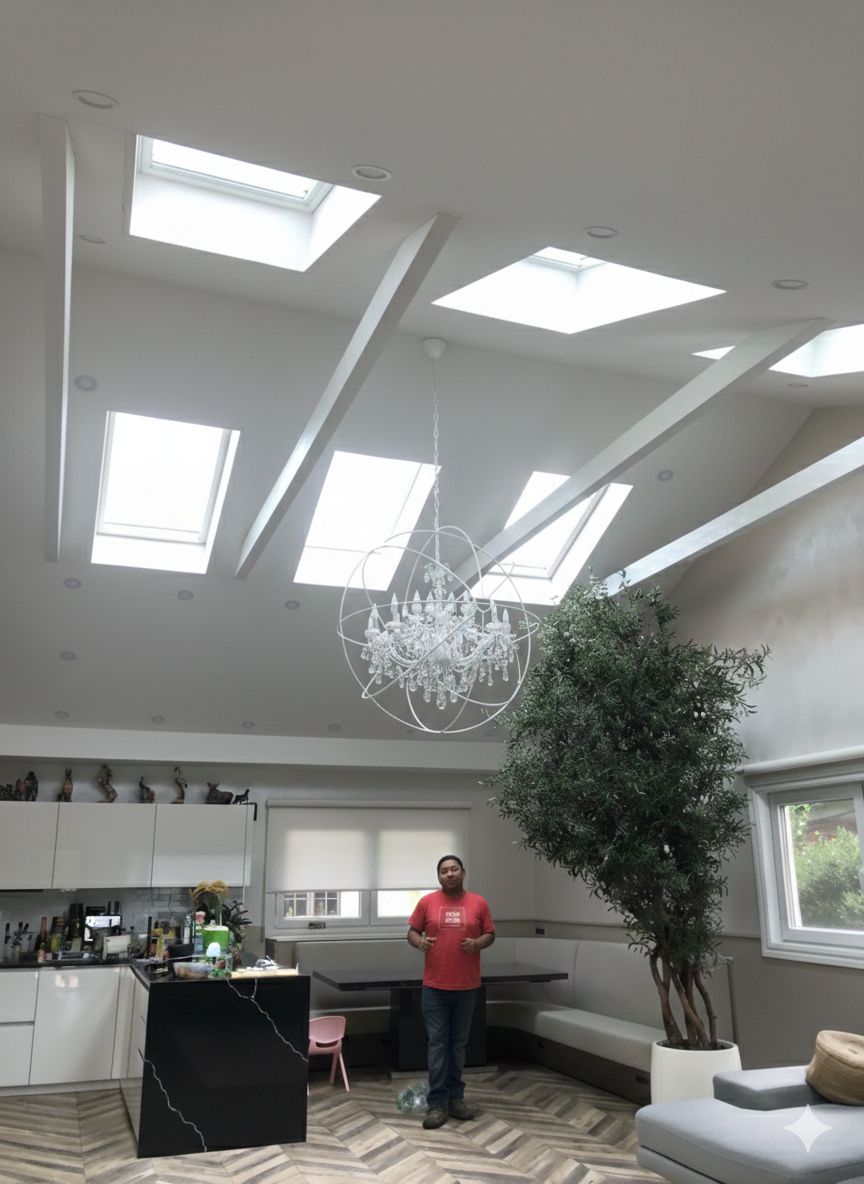
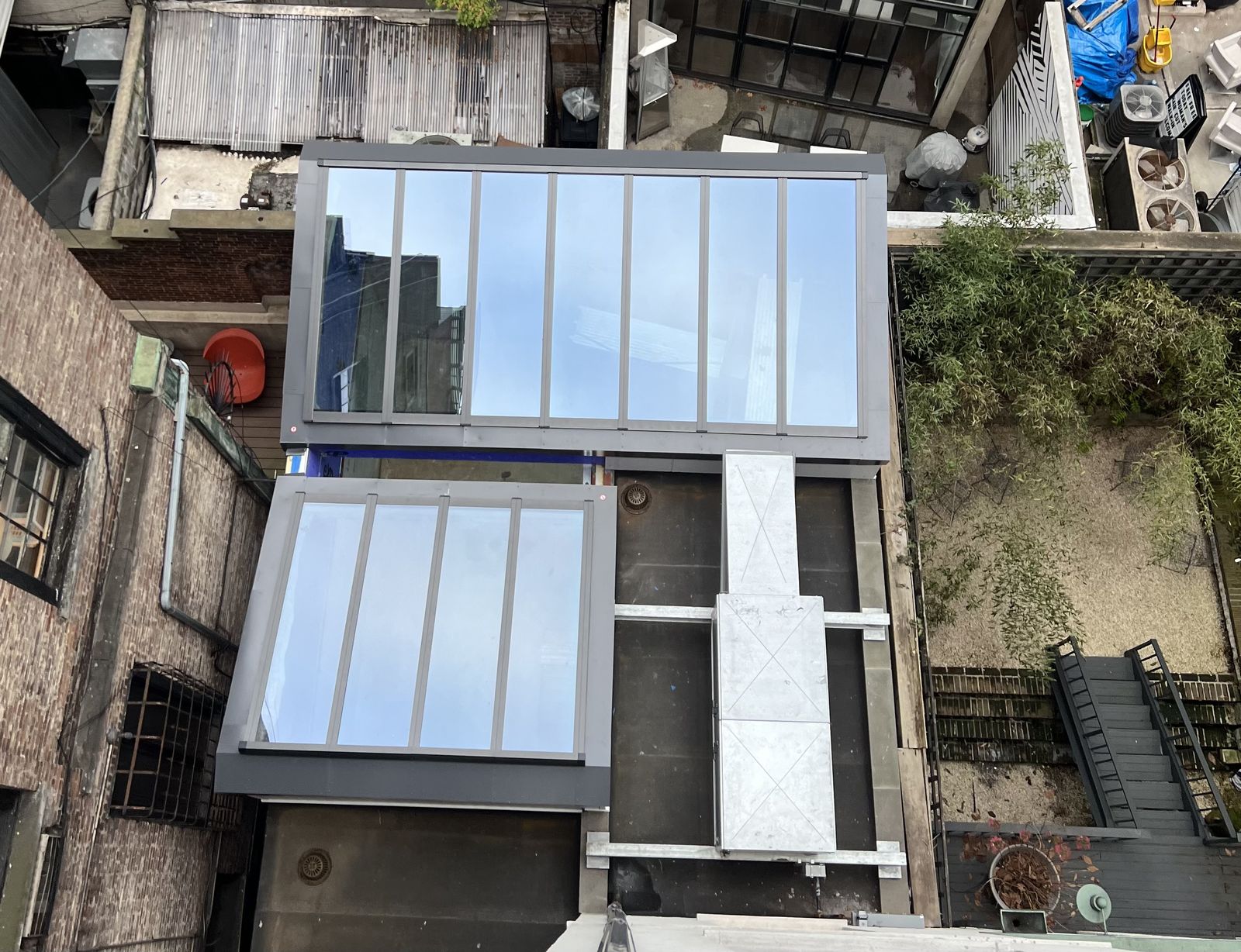
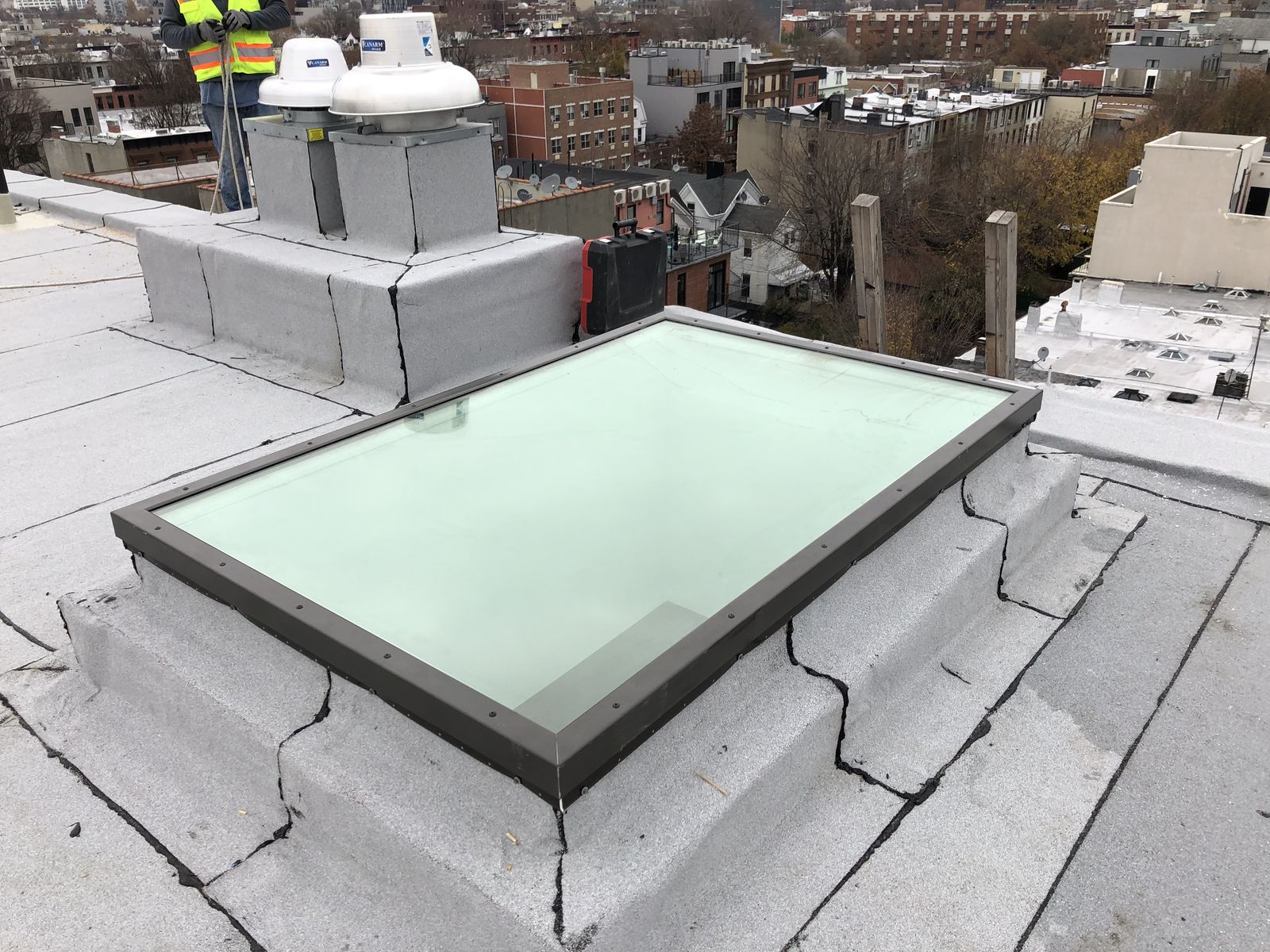
Washington Heights is built on a ridge, and the roofs show it. The bulk of the neighborhood is six storey walk-ups and elevator buildings put up between about 1910 and 1940, with flat roofs, high parapets and stair and elevator bulkheads standing proud of them. Scattered among that there are row houses, including the wood frame rows around Jumel Terrace and Sylvan Terrace that are older than almost anything else left in Manhattan, and up on the high ground the Hudson Heights co-ops sit where the wind comes straight off the river. Flat roofs mean curb mounted units, and exposure means the flashing detail has to be better than average. Replacement on a sound curb starts at $2,287 installed and a brand new opening starts at $3,850.
This is most of the housing stock here, and it is the roof we work on most. Six storeys, flat roof, parapet all the way round, a stair bulkhead and sometimes an elevator bulkhead. The two jobs these buildings produce are the top floor apartment that has an interior room with no window, and the building's own stair glazing, which on a building of this age is usually original and usually wire glass in steel. The first is a shareholder's job that the board has to approve, the second is the building's own work. Either way the roof belongs to the corporation, so the specification goes to the managing agent before anything is ordered.
There are blocks here where the houses are wood frame, built in the 1880s, and that is rare enough in Manhattan that it changes how we work. Old framing on uneven spacing, a century of reroofing stacked on the deck, and a stair skylight at the top that has been reglazed more than once. On a frame house we check what the curb is actually fastened to before anything gets cut, and we build the curb up through the full stack of roofs so the flashing lands on top of the finished roof instead of being buried in the middle of it. These are also the blocks most likely to be regulated, so the unit has to be the kind nobody can see from the street.
Up on the high ground the buildings are mostly 1930s co-ops with large flat roofs, and the thing that is different is exposure. Wind coming off the Hudson drives rain horizontally at the roof, and horizontal rain finds a flashing detail that would be perfectly adequate on a sheltered Brooklyn block. When a skylight on this side of the neighborhood only leaks in a storm and stays dry in ordinary rain, that is almost never the glass. It is water getting under or behind the flashing because the curb is too low or the upstand is too short for the exposure.
This is worth its own paragraph because it is the most misdiagnosed problem we see up here. A skylight that is dry for weeks and then wets a ceiling during a nor'easter has a water entry path that only opens under wind pressure. Caulking the outside of the glass does nothing for it and is the usual first attempt. What fixes it is raising the curb, lengthening the upstand and reflashing so that wind driven water has to climb further than it can. We find that by opening the detail up, not by sealing it from above.
Several designated districts sit inside this neighborhood, including Jumel Terrace, Audubon Park and Audubon Terrace, and the great majority of addresses here are outside all of them. We check the address against the designated areas before specifying, because that is what decides whether the unit has to be invisible from the street. On a regulated row house the answer is a low profile flat glass unit set behind the parapet. On the 1920s apartment buildings, which are mostly not regulated, there is more room to choose.
In a one or two family house it is the owner plus a permit where the work requires one. In a co-op, which is most of the neighborhood, it is the board through the managing agent, and they will want the unit specification, our New York City home improvement license 2084179 and our insurance certificates, and in some buildings an engineer's letter on the roof deck. We put that together before you go to the board, because a board without a specification in front of it has no way to say yes.
Already leaking, or not sure what failed? Read more about skylight repair in Manhattan, what a leaking skylight normally turns out to be, or see our published prices.
A water path that only opens under wind pressure, and up on the ridge that is common because rain comes in sideways off the river. It is almost never the glass. The usual cause is a curb that is too low or an upstand that is too short for the exposure, so wind driven water gets behind the flashing. Sealing the outside of the glass does nothing for it. Raising the curb and reflashing does.
Often yes. What decides it is the roof above you, what is already sitting on it, and how far the roof deck is above your ceiling. The board has to approve it because the roof belongs to the corporation, so we prepare the unit specification, our license 2084179 and our insurance certificates for the managing agent before anything is ordered.
Probably not, because the designated areas here are small. Jumel Terrace, Audubon Park and Audubon Terrace are designated and the great majority of Washington Heights is outside all of them. We check your address against the designated areas before specifying anything. On a regulated address the answer is a low profile flat glass unit behind the parapet; off one, there is more room to choose.
Quite a lot, and it is worth saying out loud because frame houses are rare in Manhattan. The framing is old and not always evenly spaced, and after a century of reroofing there can be three or four roofs stacked on the deck. We check what the curb is fastened to before anything is cut, and we build the curb up through the whole stack so the flashing finishes on top of the finished roof instead of inside it.
Because of the curb, nearly always. The published $2,287 installed is a fixed replacement on a curb that is sound, and on a building that has been reroofed three or four times the curb often is not. The other reasons are a light shaft between the roof deck and the ceiling, a venting unit instead of a fixed one, and access that needs more than two people carrying it up. We tell you which of those applies after seeing the roof, not after the invoice.
If it is cracked, if the steel is rusting under the paint, or if water is running down the stair wall, yes. Wire glass is not safety glass in any modern reading even though the mesh suggests otherwise, and a cracked pane in a steel frame will sit there looking fine while the frame leaks around it. The replacement is insulated glass in a unit made to the existing opening, so the masonry normally stays untouched.
Yes, and in a building of this age that is usually the right choice. A solar venting unit carries its own panel and battery, so no circuit has to be run to the roof. It opens on a remote and closes itself when the rain sensor gets wet, which matters more than usual on an exposed roof. A manual crank or pole unit works where the ceiling is reachable.
Through the building and up the stairs in most cases, which is normal work for us on upper Manhattan buildings. Unit sizes on these roofs are usually carryable. Where a sheet is too large or too heavy to move safely we say so at the measure and the access method is priced into the job rather than appearing as a surprise on the day.
Either. We deliver to the job site, or you collect from us on Gerritsen Avenue in Brooklyn, whichever suits the schedule. Units start at $527 with the flashing kit matched to your roof covering and New York City sales tax included, and we size it and pick the mount before anything is ordered so the wrong thing does not turn up. Roofers and general contractors should look at our contractor page.
Call (718) 646-7053 and say it is live, because active leaks go to the front of the schedule. In the meantime do not let anyone caulk the outside of the glass, which is the usual reflex and makes the diagnosis harder by hiding where water is getting in. Put something under it, keep people off the stair if plaster is coming down, and let us open the detail up and see the actual path.
Upper East Side · Upper West Side · Yorkville · Harlem · Morningside Heights · Gramercy · Murray Hill · Chelsea · Greenwich Village · West Village · SoHo · Tribeca
We cover every part of the borough. See skylights in Manhattan, our published prices, or NYC permits and landmark rules. Serving 10032, 10033 and 10040.