Recent skylight work
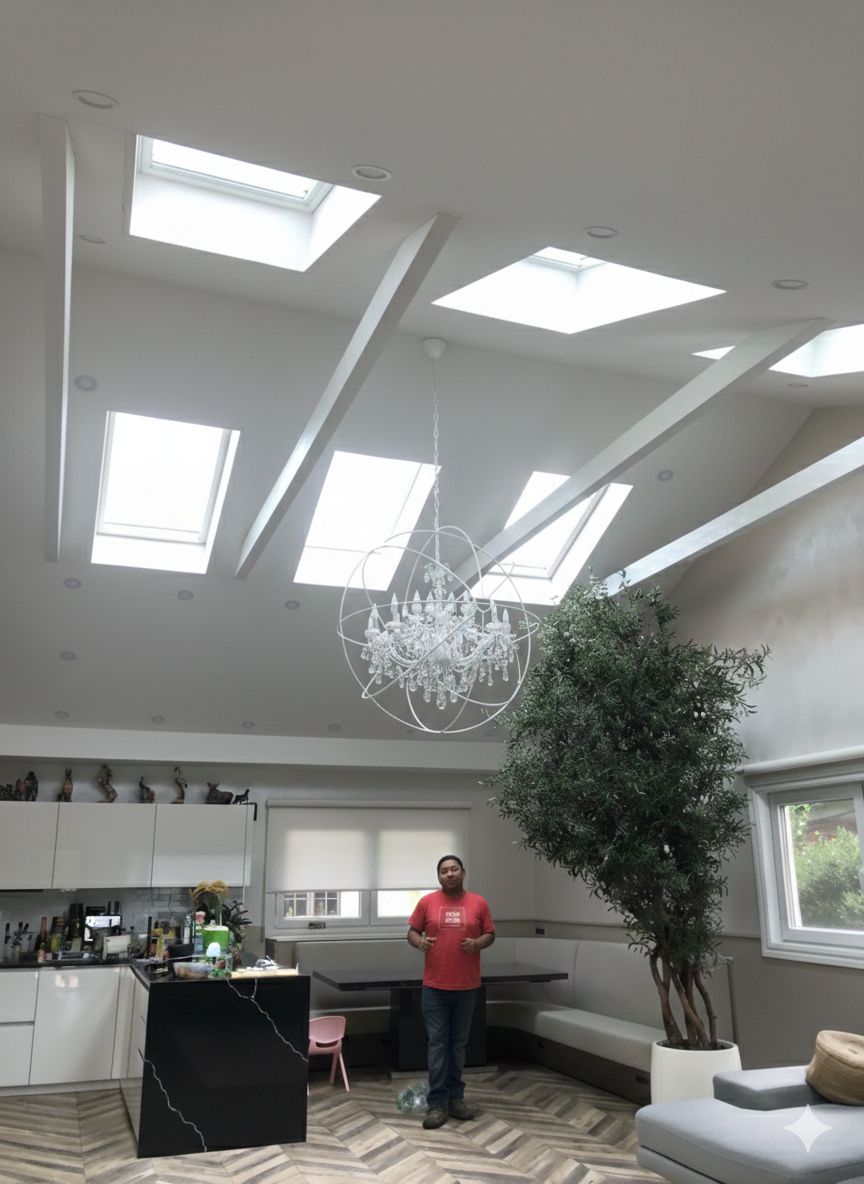
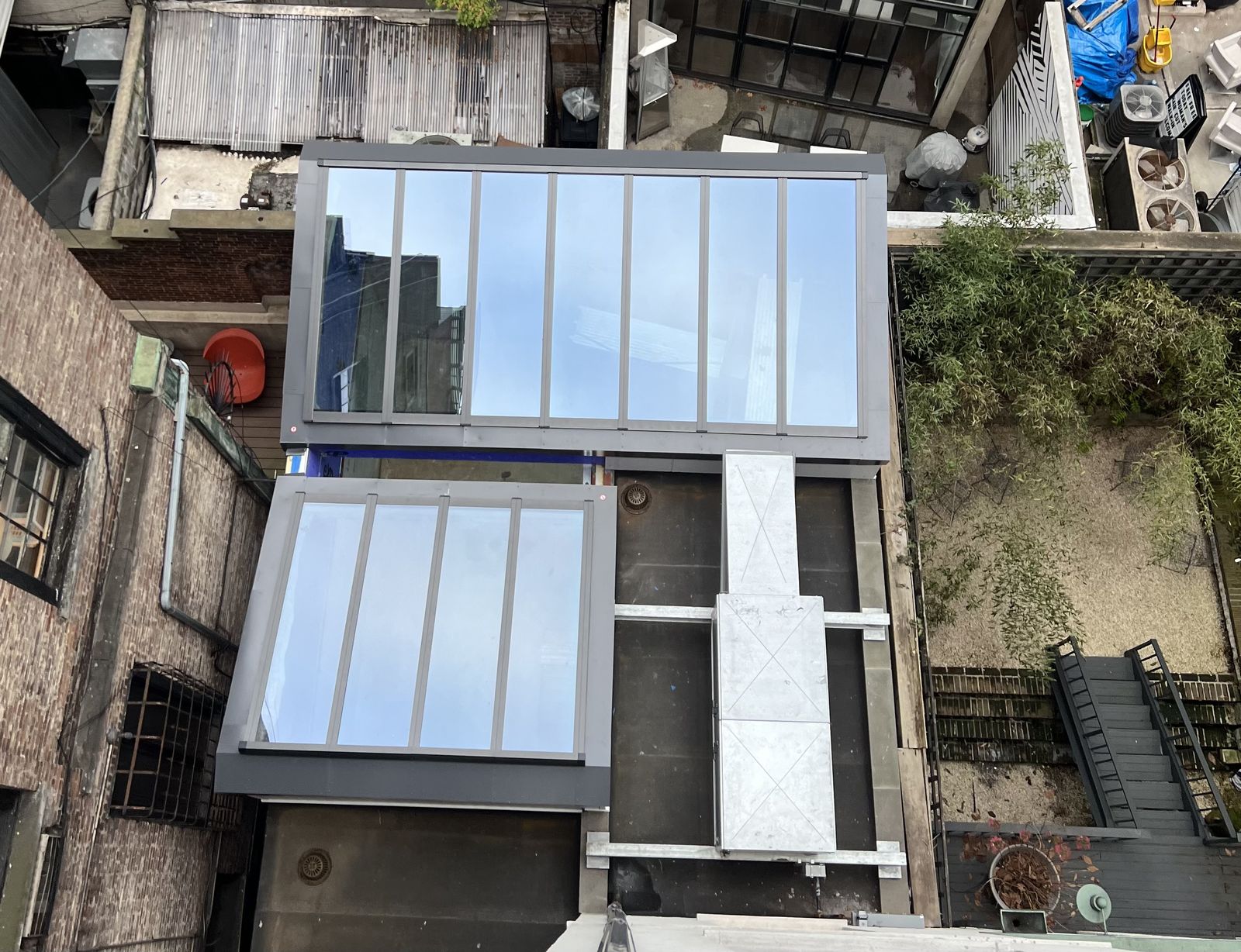
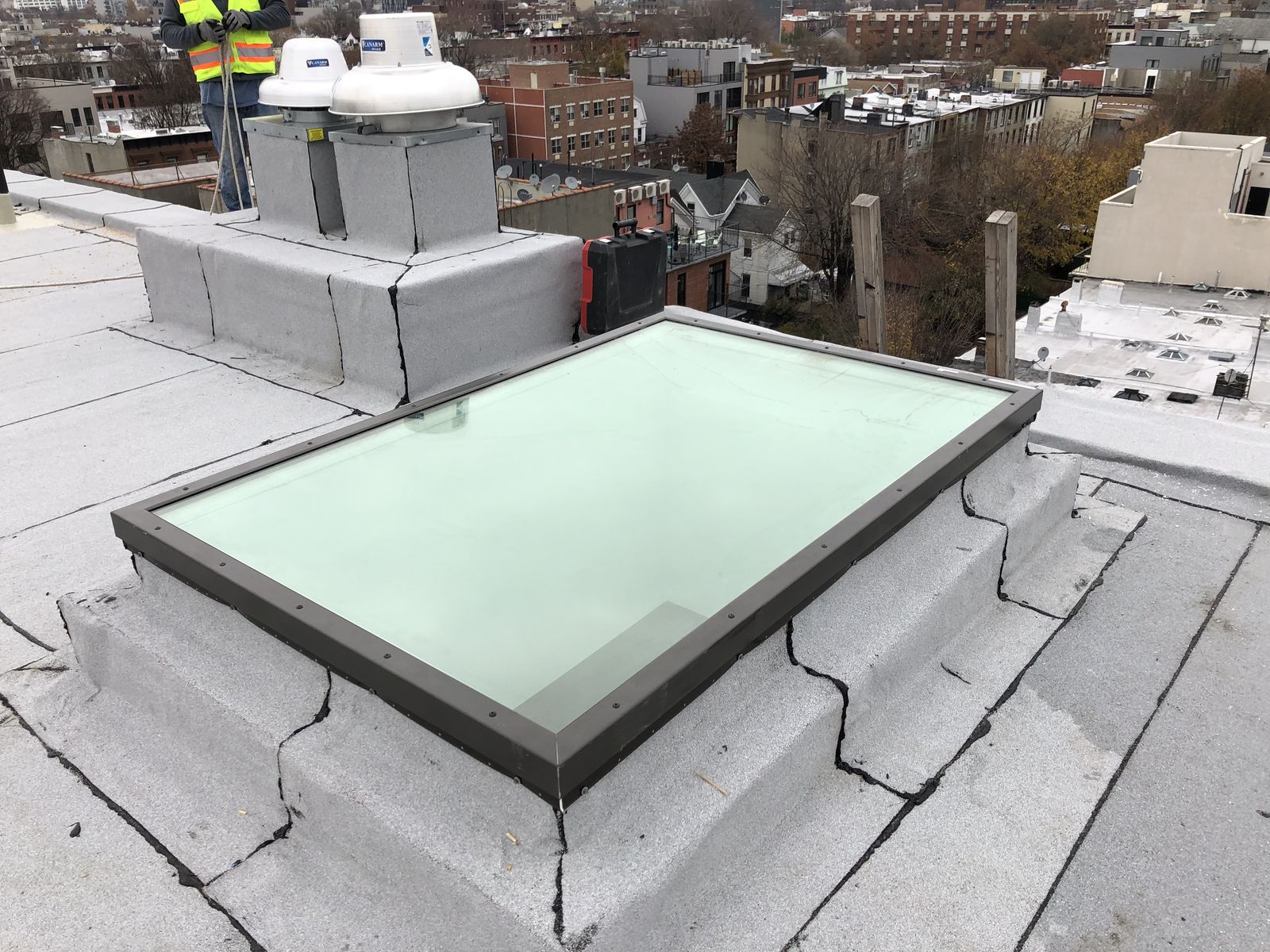
Gramercy is a small neighborhood carrying three different kinds of roof, and which one you have decides most of the job before anyone prices it. There are the 1840s and 1850s brick and brownstone row houses on the park and the blocks running off it, there are the prewar elevator buildings along Irving Place, Third Avenue and the East 20s that are nearly all co-ops now, and there are the one and two storey rear extensions sitting behind the houses. Almost every one of those roofs is flat or close to flat, so the unit is curb mounted and the curb is where the job is won or lost. Replacement on a sound curb starts at $2,287 installed and a brand new opening starts at $3,850.
Twenty to twenty five feet wide, four and five storeys, built before the Civil War in most cases, with a flat main roof behind a low parapet and a stair bulkhead at the back of it. The job these houses produce most often is the skylight over the stairwell, because on a plan that narrow the stair is the only route daylight has into the middle of the floor. Many of those openings are original and have been glazed four or five times since, each time over the last curb, so the first thing we do is find out how many roofs are stacked on the deck and what the curb is actually fastened to. A curb that was built up with furring and tar forty years ago is not something to set new glass on, and that is a rebuild rather than a swap.
Irving Place, Gramercy Park East and the avenue blocks are mostly six to fourteen storey buildings from the 1910s and 1920s. The roofs are large, flat, and already carry water tanks, elevator machine rooms and air handling equipment, so a top floor apartment that wants light is working around whatever is already up there. What is usually possible is a unit over a top floor bathroom, a kitchen or an interior hall, and a light shaft if the ceiling is a long way below the roof deck. In a building like this the roof belongs to the corporation, not to the shareholder, so the technical answer is the easy half and the approval is the real work.
The low roof behind a Gramercy row house, over a kitchen or a garden floor extension, is the cheapest light in the neighborhood and the most often ignored. It is close to the ground, easy to reach, and usually has nothing on it. The catch is that it is also the roof most likely to have been built in pieces over a century, with pitch that runs the wrong way and a parapet that holds water against the house wall. We set the curb high enough that the flashing sits on top of the finished roof rather than inside it, which is the difference between a skylight that leaks in year two and one that does not.
Two things turn up over and over on these blocks. One is a panel of wire glass in a rusted steel frame over a stair, which is original or close to it, and which is not safety glass by any modern reading even though people assume it is. The other is an acrylic dome fitted somewhere between 1975 and 1995, now yellowed, crazed and brittle enough to crack when you lean on the curb. Both get replaced with insulated glass in a unit sized to the existing opening wherever the opening allows it, and both are jobs where the condition of the curb underneath matters more than the glass on top.
The blocks immediately around the park sit inside the Gramercy Park Historic District, and there is an extension to it as well, so a good number of addresses here are regulated and a good number a few streets away are not. We do not guess. We check the address against the designated area before anything is specified, because a flat glass unit set low behind a parapet and not visible from the street is a different conversation with the Landmarks Preservation Commission than a raised lantern that is. On a regulated address the practical answer is almost always a low profile unit that nobody can see from the sidewalk.
In a single family or two family house it is the owner and, when the work needs one, a permit. In a co-op or condominium it is the board, through the managing agent, and they will want the unit specification, our license and insurance certificates, and in some buildings a letter from an engineer about the roof deck. We put that package together as a matter of course because without it a board cannot say yes, and a board that cannot say yes says no. We hold New York City home improvement license 2084179 and we are a VELUX Trained and Approved installer, which is the paperwork these buildings ask for.
Already leaking, or not sure what failed? Read more about skylight repair in Manhattan, what a leaking skylight normally turns out to be, or see our published prices.
If you are on the park or the blocks immediately around it, very likely yes, and there is an extension to the district as well. A few streets away and the answer is often no. We check your actual address against the designated areas rather than going by the neighborhood name, because that one answer decides whether the unit has to be invisible from the sidewalk.
The unit cut sheet with the exact model and glazing, the opening size, how the curb and flashing are built, our New York City home improvement license 2084179, our insurance certificates, and the scope in plain language so a board that is not made up of builders can read it. If the building wants an engineer's letter on the roof deck we will tell you that up front rather than after the vote.
Open the curb and look before deciding. On a house that has been reroofed three or four times the glass is often the newest part of the assembly and the curb underneath is soft wood, furring and tar. New glass on a bad curb leaks again in a season or two. If the curb is sound it is a straight replacement from $2,287 installed, and if it is not, the curb gets rebuilt first and we tell you that after we have seen it, not before.
That is one of the better opportunities here. The extension roof is low, reachable and usually empty, and it sits directly over a kitchen or a garden floor room that has no other light. The thing to watch is the drainage, because these roofs were often built in stages and the pitch does not always run away from the house wall. We set the curb high and flash on top of the finished roof so water has nowhere to sit.
The unit and the labor are the same. What differs is everything around them. A row house owner can decide on Monday and have work booked for Thursday. A co-op needs a specification in front of a board first, and a building that wants an engineer's letter adds that cost and that wait. The published starting figures are $2,287 installed for a fixed replacement on a sound curb and $3,850 for a brand new opening, and neither changes because of the kind of building.
Not with the glass that goes in now. A modern insulated unit has a low emissivity coating and a coated outer pane, so it carries far less heat than the single pane or the acrylic dome it is replacing. The honest exception is a large area of south facing glass over a small room, and where that is the case we say so and talk about shading or a venting unit instead of selling you the bigger piece of glass.
Not if it is a solar unit, and in a prewar building that is usually what decides it. A solar venting unit brings its own panel and battery, opens on a remote and closes itself on a rain sensor, with no circuit to run to the roof. A manual venting unit on a crank or a pole also works when the ceiling is reachable. In a co-op the roof belongs to the corporation either way, so the approval comes first.
Not necessarily, and we do not start by blaming anyone. The usual finding is that the new roof was run up to the existing curb and terminated against it instead of the curb being rebuilt to sit above the new membrane. Water then tracks in behind the flashing. That is a curb and flashing problem rather than a glass problem, and it is diagnosed by opening it, not by looking at it from the street.
Both. Supply only is a real part of the business rather than a favor. We size it, pick the mount and the flashing to suit your roof covering, and the unit starts at $527 with the flashing kit and New York City sales tax included. Delivery to the job or collection from us on Gerritsen Avenue in Brooklyn. If you are a roofer or a general contractor, our contractor page covers the trade side.
No. The professional assessment is free, and it is a real one: somebody gets on the roof, opens up what has to be opened and tells you what actually failed. Call (718) 646-7053 to book it. If water is coming into the building right now, say that on the call, because active leaks move up the schedule.
Upper East Side · Upper West Side · Yorkville · Harlem · Morningside Heights · Washington Heights · Murray Hill · Chelsea · Greenwich Village · West Village · SoHo · Tribeca
We cover every part of the borough. See skylights in Manhattan, our published prices, or NYC permits and landmark rules. Serving 10003, 10010 and 10016.