Recent skylight work
Murray Hill looks like one neighborhood and behaves like two. On the side streets from the East 30s up to 39th Street there are brick and brownstone row houses from the 1850s to the 1870s, narrow, four and five storeys, with flat roofs and a stair bulkhead at the back. On the avenues and the corners there are prewar and postwar elevator buildings with large roofs that already carry tanks, cooling towers and mechanical plant. A third of the row houses are not houses any more, they were cut up into offices, medical suites and small apartment buildings decades ago, and that changes who has to approve the work more than it changes the roof. Replacement on a sound curb starts at $2,287 installed and a brand new opening starts at $3,850.
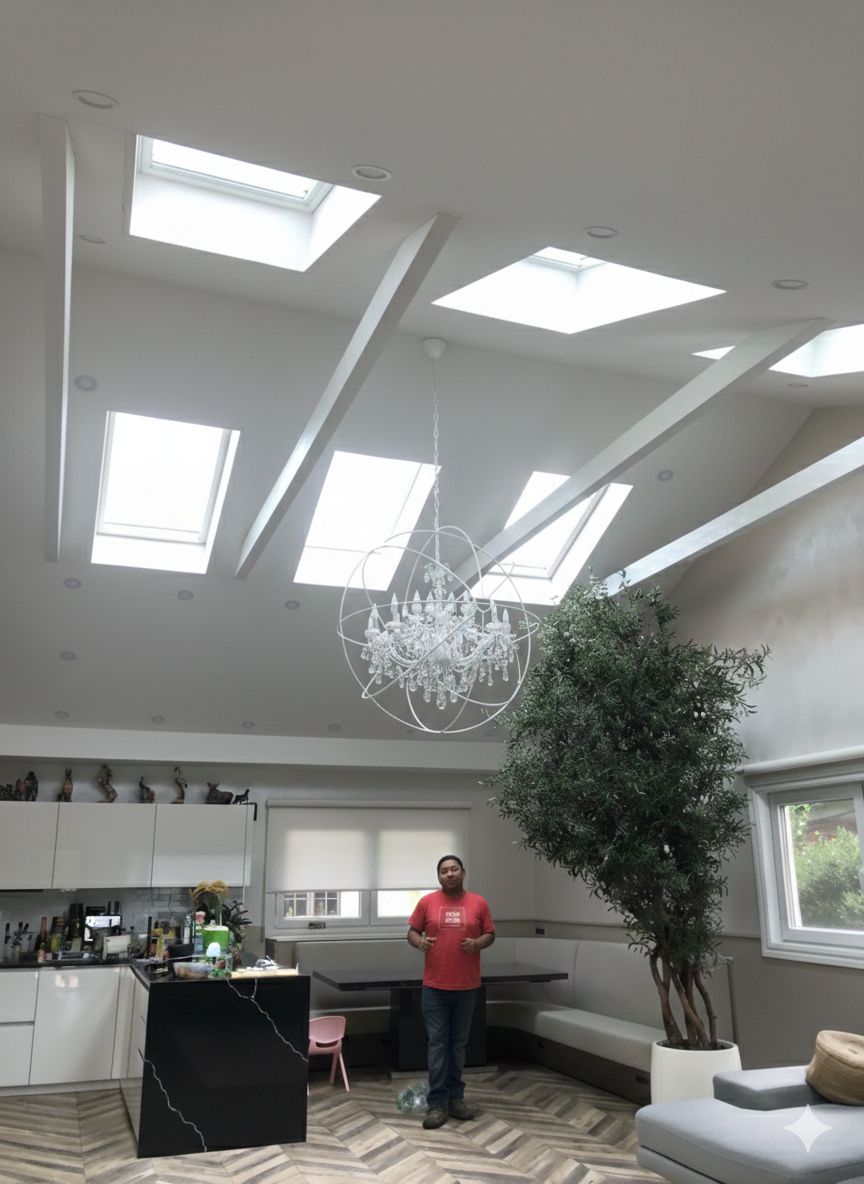
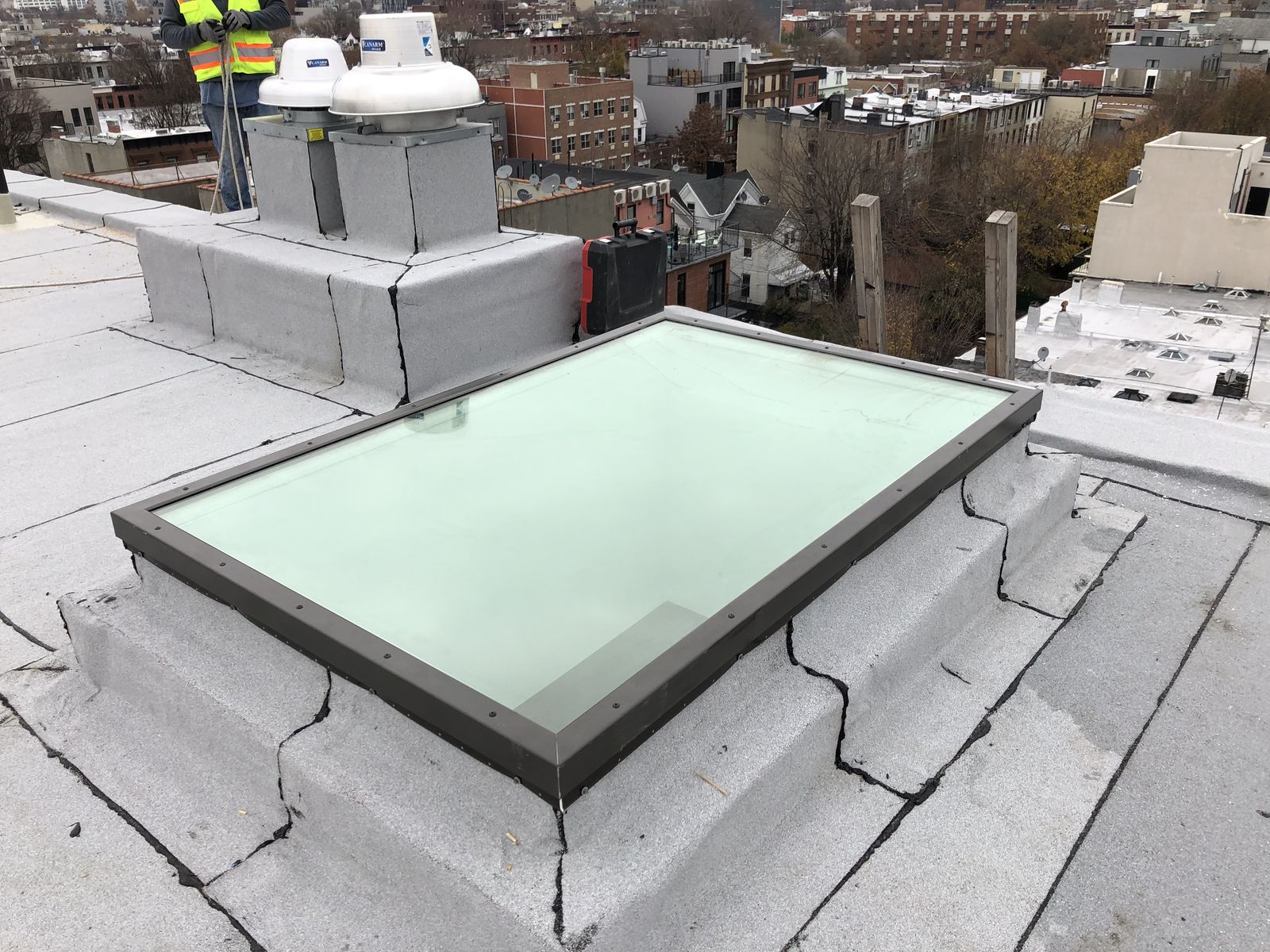
These are the blocks the neighborhood is really made of. Twenty to twenty two feet wide in many cases, flat main roof behind a parapet, and an original stair opening at the top that has been reglazed several times. Because the plan is narrow and deep, the stair skylight is the only daylight the center of the house ever gets, and a house that lost its skylight during some earlier renovation is noticeably darker than the one next door that kept it. Those openings can usually be reopened. What we check first is how many layers of roof are stacked on the deck, because the curb has to come up through all of them so the flashing finishes on top of the roof rather than being buried inside it.
A large share of the Murray Hill row house stock was converted long ago, and the conversions left their mark on the roof. There are closed up light shafts, old vent stacks that serve nothing, patched openings where something used to be, and in a number of buildings a stair skylight that was simply roofed over when the top floor was reconfigured. All of that is workable. It just means the first visit is as much archaeology as measurement, and it is also why we do not quote these buildings over the phone.
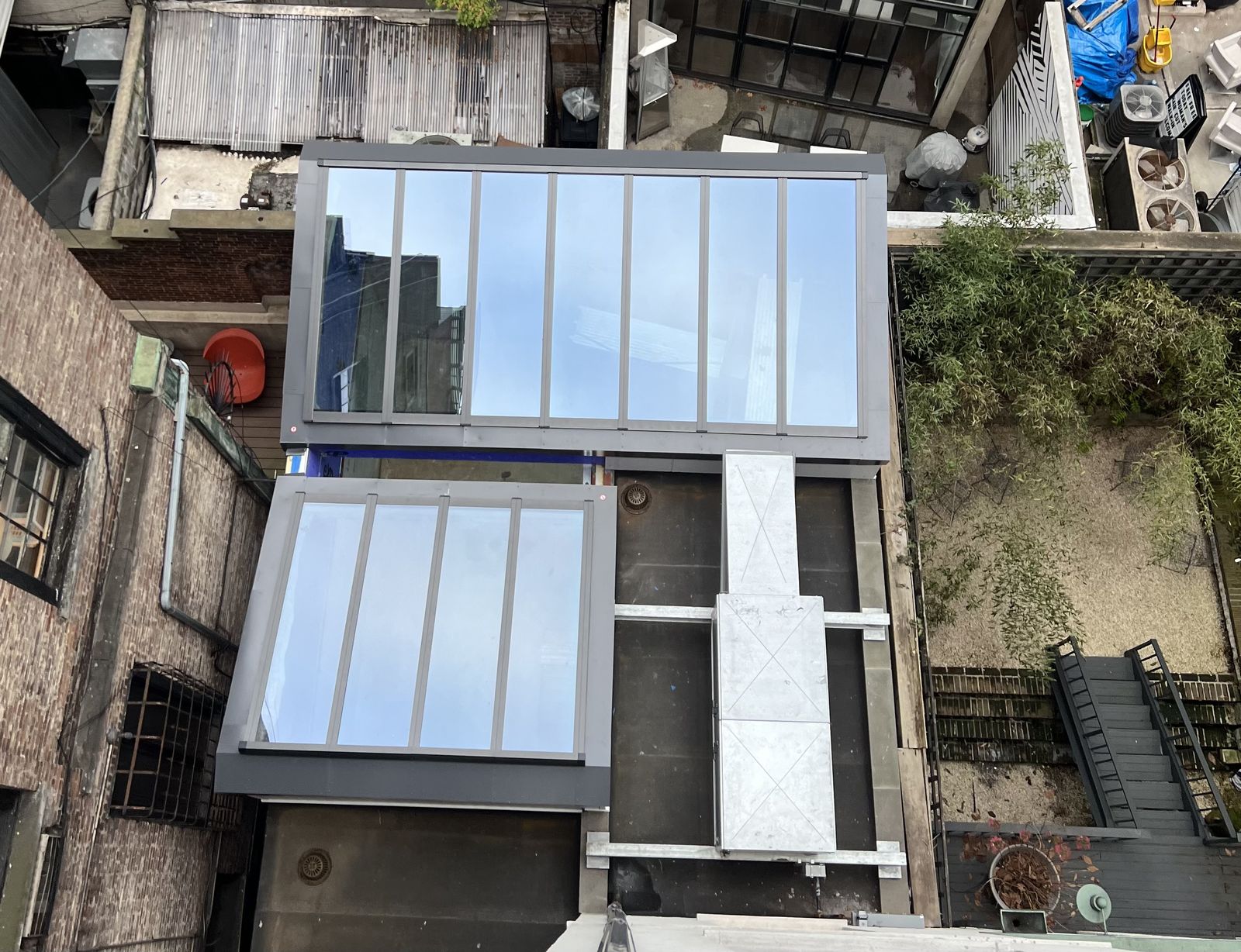
On the avenue buildings and on a lot of the converted houses the roof is not empty. Condensers, cooling towers, tanks, antenna mounts and sometimes a later penthouse addition take up the clear area, and the clear area is where a skylight has to go. The practical approach is to place the unit where the roof is already free and let that decide which room gets the light, rather than picking the room first and then finding there is a chiller sitting over it. We measure the roof, not just the ceiling.
The original glazing over a lot of these stairs is wire glass set in a steel frame, and the frame has usually been painted over so many times that it looks solid when it is rusting underneath. Wire glass is not safety glass in any modern sense, which surprises most owners, and a pane that cracks in a steel frame tends to stay in place looking fine while water runs past it. These get replaced with insulated glass in a unit sized to the existing opening wherever the opening allows, and the steel gets assessed honestly rather than painted again.
Part of Murray Hill is a designated historic district, and so is Sniffen Court, and a great many addresses nearby are not regulated at all. We check the address against the designated areas before specifying anything, because that determines whether the unit has to be invisible from the street. On a regulated building the answer is normally a low profile flat glass unit set behind the parapet where nobody on the sidewalk can see it, which is the same unit we would recommend on most of these roofs anyway.
This is the part that catches people out here. In a single family house it is the owner plus a permit where the work needs one. In a co-op or condominium it is the board through the managing agent. In a converted commercial or professional building it may be a landlord, a net lessee, or a managing agent who has never been asked about a skylight before, and the request usually has to arrive with the specification already attached. We put that package together in advance: unit cut sheet, opening size, curb and flashing detail, New York City home improvement license 2084179, and our insurance certificates.
Already leaking, or not sure what failed? Read more about skylight repair in Manhattan, what a leaking skylight normally turns out to be, or see our published prices.
Normally a low profile flat glass unit set behind the parapet where the street cannot see it, which on these flat roofs is the unit we would specify anyway. Raised lanterns and anything that breaks the roofline are the hard conversations. Sniffen Court is designated separately, and a great many addresses nearby are in no district at all, so the first thing we do is check your address.
Whoever controls the roof, and in a converted building that is often not obvious. It can be the owner, a net lessee or a managing agent. The way to get an answer rather than a delay is to send the request with the specification already attached, so we prepare the unit cut sheet, the opening size, the curb and flashing detail, our license 2084179 and our insurance certificates before you ask.
Usually, and on a narrow Murray Hill row house it is worth doing because the stair is the only way light reaches the middle of the plan. We open up and look at what was done, because a closed opening is sometimes just decked over and sometimes the framing was cut and headed off. Those are two different jobs and we will not guess which one you have before seeing it.
Nearly always, but the equipment decides the location. We survey what is actually on the roof and where the clear area is, then work out which room sits under it. Picking the room first and hoping the roof above it is free is how people end up disappointed. On a crowded roof a smaller unit in the right place beats a large one that cannot go anywhere.
The labor, on most jobs. On the commonest one, a fixed replacement on a sound flat roof curb, it is $527 for the unit and $1,760 for the labor, which comes to $2,287 installed. A manual venting unit starts at $2,852 and a solar venting unit starts at $3,860, and there the extra is all in the unit rather than the work. A brand new opening starts at $3,850 and that one is mostly labor.
No, and that catches nearly everyone out. Wire glass is not safety glass under any modern reading. The mesh was there to hold the pane together in a fire, not to stop somebody falling through it, and the steel frame holding it is usually rusting under layers of paint. A cracked pane in a steel frame also tends to sit there looking intact while water tracks past the frame.
No, and that is the normal situation in a prewar Murray Hill building. A solar venting unit carries its own panel and battery, so nothing has to be run up to the roof, which is otherwise the part that kills the job. It opens on a remote and closes itself when the rain sensor gets wet. A manual crank or pole unit is the other way to do it where the ceiling can be reached.
After the roof is sorted and before the ceiling closes, and the sequence matters more than people expect. If the roof is being replaced, the curb should be built as part of that work so the new membrane finishes against a curb that is already at the right height. Doing it the other way round, running the roof up to an old curb, is the single most common reason a two year old roof still leaks at the skylight.
Yes, and that is a normal arrangement here. We size the unit, pick the mount and the flashing for the roof covering he is working with, and he sets it. Units start at $527 with the flashing kit and New York City sales tax included. He can collect from us on Gerritsen Avenue in Brooklyn or we deliver to the job. Our contractor page covers how we work with the trade.
Yes. You get the unit model and glazing, the opening size, how the curb and flashing are built and what is and is not included, in writing. That is partly so a board can read it and partly so you can compare like with like, because the thing that makes two skylight quotes differ by thousands is almost always whether the curb is being rebuilt. Call (718) 646-7053 and we will come and measure.
Upper East Side · Upper West Side · Yorkville · Harlem · Morningside Heights · Washington Heights · Gramercy · Chelsea · Greenwich Village · West Village · SoHo · Tribeca
We cover every part of the borough. See skylights in Manhattan, our published prices, or NYC permits and landmark rules. Serving 10016 and 10017.